So, you’re thinking about becoming an HVAC technician. Great choice! The field is stable, hands-on, and offers opportunities to solve real-world problems. But here’s the catch: not all HVAC careers are the same. The biggest fork in the road is choosing between a commercial HVAC tech career path and a residential HVAC tech career path. Let’s break down the differences, from training and salaries to daily work life, so you can decide which path fits your goals.
What Do HVAC Technicians Actually Do?
Before we dive into specifics, let’s clarify the basics. HVAC stands for Heating, Ventilation, and Air Conditioning. Technicians in this field install, maintain, and repair systems that control temperature and air quality. But where they work—homes vs. businesses—shapes nearly everything about their jobs.
Commercial HVAC Tech Career Path vs. Residential: Key Differences
1. Training and Certifications
Both paths start with foundational HVAC training, but they branch out quickly.
Residential HVAC Tech Career Path
Education: Most residential techs complete a 6-month to 2-year program at a trade school or community college. Apprenticeships are also common.
Certifications: Basic EPA 608 certification (for handling refrigerants) is mandatory. Optional credentials like NATE or HVAC Excellence can boost job prospects.
Licensing: Many states require a license to work independently. For example, Texas mandates a license for HVAC contractors through the Texas Department of Licensing and Regulation.
Commercial HVAC Tech Career Path
Education: Longer training periods are typical. Programs often include advanced coursework in industrial systems, building automation, and refrigeration.
Certifications: Beyond the EPA 608, commercial techs might pursue specialized certs like RETA’s COOL for industrial refrigeration or OSHA safety certifications.
Licensing: Commercial work may require additional state or municipal licenses, especially for large-scale projects.
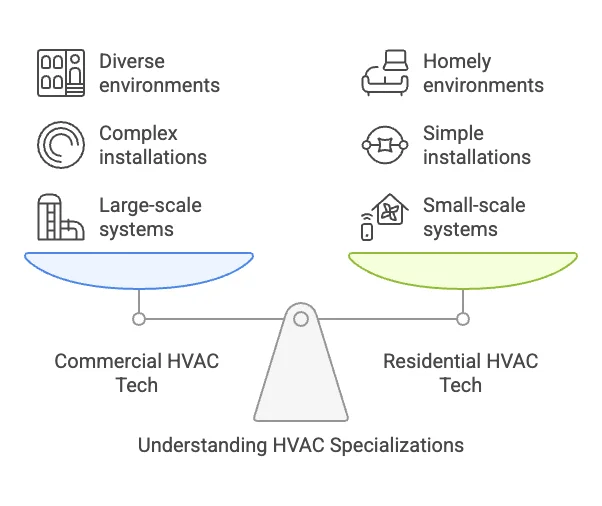
Key Insight: Commercial HVAC systems are more complex (think rooftop units, chillers, and VRF systems), so techs need deeper technical knowledge.
2. Work Environment and Daily Tasks
Residential HVAC Techs
Where They Work: Single-family homes, apartments, small buildings.
Tasks: Installing ductwork, servicing furnaces, troubleshooting thermostats.
Customer Interaction: High. You’ll explain issues to homeowners, recommend repairs, and sometimes upsell services.
Hours: Seasonal spikes (summer AC repairs, winter furnace fixes) mean busy summers and winters, with slower spring/fall months.
Commercial HVAC Techs
Where They Work: Office buildings, factories, hospitals, schools.
Tasks: Maintaining rooftop units, repairing industrial chillers, optimizing energy efficiency in large buildings.
Customer Interaction: Low. You’ll often report to facility managers or corporate clients.
Hours: More consistent year-round. Emergencies happen, but contracts with businesses provide steady work.
The Big Difference: Commercial techs often work in teams and face physically demanding conditions (e.g., climbing ladders to access rooftop units). Residential techs juggle customer service and technical skills.
3. Commercial HVAC Tech Salary vs. Residential
Let’s talk numbers. Salary is a major factor, but it’s not just about base pay.
| Factor | Residential HVAC Tech | Commercial HVAC Tech |
|---|---|---|
| Median Annual Salary | $48,730 (BLS) | $55,888 (ZipRecruiter) |
| Income Stability | Seasonal fluctuations | Steady year-round work |
| Overtime Opportunities | Common during heat waves/cold snaps | Less frequent, but higher-paying contracts |
| Commission Potential | Upselling filters, maintenance plans | Rare (focus on service contracts) |
Residential HVAC Tech Salary
Entry-level: $35,000 - $40,000
Experienced: Up to $65,000+ (with commissions or business ownership)
Commercial HVAC Tech Salary
Entry-level: $45,000 - $50,000
Experienced: $70,000 - $90,000 (especially with specialized certifications)
Why the Gap? Commercial systems are more complex, and techs often need advanced skills. Plus, businesses pay premiums to avoid downtime.
4. Career Growth and HVAC Tech Job Opportunities
Residential HVAC Career Path
Pros: Flexibility to start your own business, build customer relationships, and work independently.
Cons: Income can dip during off-seasons. Competition is fierce in crowded markets.
Commercial HVAC Career Path
Pros: Higher earning potential, opportunities to specialize (e.g., data center cooling), and advancement into supervisory roles.
Cons: Physically demanding work. Requires continuous learning as systems evolve.
Job Outlook: The BLS projects 5% growth for HVAC jobs through 2030, driven by demand for energy-efficient systems. Commercial techs may see stronger demand as businesses prioritize sustainability.
5. The Good and the Not-So-Good
Residential HVAC Pros
Direct impact: Fixing a family’s broken AC on a hot day feels rewarding.
Entrepreneurial path: Start your own HVAC company with lower upfront costs.
Residential HVAC Cons
“Feast or famine” workload.
Pressure to meet sales quotas at some companies.
Commercial HVAC Pros
Challenging projects: Solving puzzles like optimizing a 20-story building’s airflow.
Stability: Businesses sign long-term maintenance contracts.
Commercial HVAC Cons
Harsh conditions: Working in attics, rooftops, or freezing warehouses.
Less autonomy: You’re part of a larger team or corporate structure.
How Much Does an HVAC Tech Make? It Depends on Your Path
We’ve touched on salaries, but let’s dig deeper. Location matters too. For example:
In Massachusetts, entry-level residential techs earn around $47,000 - $60,000.
States with extreme weather (Texas, Arizona) have higher demand—and pay—for both paths.
Tip: Use tools like PayScale or the BLS Occupational Outlook Handbook to research salaries in your area.
Which Path Should You Choose?
Ask yourself:
Do you prefer working with people or systems? Residential = more customer interaction. Commercial = more technical problem-solving.
Are you okay with physical labor? Commercial work is tougher on the body.
Do you want to own a business someday? Residential offers a clearer path.
Final Thoughts
Whether you choose residential or commercial HVAC, you’re entering a field with strong job security and opportunities to grow. Commercial techs earn more upfront, but residential techs can carve out niche businesses. Both paths require grit, continuous learning, and a knack for troubleshooting.
The Future of HVAC: Green technology is reshaping the industry. From heat pumps to smart thermostats, techs in both sectors will need to adapt. Certifications in LEED or energy auditing could set you apart.
So, which path speaks to you? Are you drawn to the hustle of residential work or the complexity of commercial systems? Either way, you’re stepping into a career that keeps the world comfortable—one HVAC system at a time.