The complete guide to HVAC Apprentice Jobs: Your Gateway to a Thriving Career
An HVAC apprentice is a trainee who works under experienced technicians to learn the installation, maintenance, and repair of heating, ventilation, and air conditioning systems. This entry-level position combines hands-on experience with classroom instruction, typically lasting 3-5 years before advancing to journeyman status. With the HVAC industry projected to grow 13% through 2032—much faster than average—according to the Bureau of Labor Statistics, apprentice positions offer exceptional career stability and growth potential.
The appeal of HVAC apprentice jobs extends beyond job security. These positions provide immediate earning potential while learning, comprehensive benefits packages, and the opportunity to master a skilled trade that's recession-resistant. Unlike many careers requiring expensive four-year degrees, HVAC apprenticeships offer a direct path to above average earnings through practical, marketable skills.
Modern HVAC systems have evolved far beyond basic heating and cooling. Today's apprentices work with sophisticated smart home integration, energy-efficient technologies, and complex commercial systems. This technological advancement means apprentices entering the field now will develop expertise in cutting-edge equipment, positioning them for long-term career success in an industry that's constantly innovating.
What Are HVAC Apprentice Job Duties and Daily Responsibilities?
HVAC apprentices perform a diverse range of tasks that evolve as their skills develop. Initially, apprentices focus on observation and basic support functions, gradually taking on more complex responsibilities under supervision. The structured progression ensures apprentices build competency systematically while contributing meaningfully to project completion.
Equipment preparation and job site setup constitute significant portions of an apprentice's early responsibilities. This includes loading and unloading tools, organizing work areas, and ensuring proper safety protocols are followed. Apprentices learn to identify and prepare the various hand tools, power tools, and specialized equipment required for different types of installations and repairs.
Measurement and cutting tasks represent the next level of responsibility. Apprentices learn to measure and cut ductwork, pipe, and tubing to specifications using hand tools and power equipment. Precision becomes critical as apprentices advance, as improperly sized components can compromise system efficiency and require costly corrections.
System component installation provides hands-on learning opportunities. Under supervision, apprentices help install furnaces, air conditioning units, heat pumps, and ductwork. They learn proper mounting techniques, connection procedures, and safety requirements for different system types. This phase teaches apprentices to read blueprints and follow manufacturer specifications.
Maintenance and repair activities expose apprentices to troubleshooting methodologies. They assist with routine maintenance tasks like filter changes, cleaning coils, and checking refrigerant levels. When repairs are needed, apprentices observe diagnostic procedures and help replace faulty components, learning to identify common failure patterns and their solutions.
Customer interaction skills develop as apprentices advance. They learn professional communication techniques, how to explain system operations to customers, and proper job site etiquette. These soft skills prove essential for career advancement, as experienced technicians often work independently and must maintain positive customer relationships.
Key Responsibilities: Installation, Maintenance, and Troubleshooting
Installation responsibilities for HVAC apprentices encompass both residential and commercial applications. In residential settings, apprentices assist with furnace and air conditioning unit replacements, ductwork modifications, and thermostat installations. They learn proper sizing calculations, load requirements, and energy efficiency considerations that impact system performance and customer satisfaction.
Commercial installation projects introduce apprentices to larger, more complex systems. These might include rooftop units, chillers, boilers, and sophisticated control systems. Apprentices learn to work with blueprints, coordinate with other trades, and understand building codes and regulations. The scale and complexity of commercial work require advanced planning and coordination skills.
Preventive maintenance forms a cornerstone of HVAC apprentice training. Regular maintenance tasks include cleaning and replacing filters, lubricating moving parts, checking electrical connections, and testing system controls. Apprentices learn that preventive maintenance extends equipment life, improves efficiency, and prevents costly emergency repairs. The Department of Energy emphasizes that proper maintenance can improve system efficiency by 5-40%.
Diagnostic troubleshooting represents the most technically challenging aspect of apprentice responsibilities. Apprentices learn systematic approaches to identifying problems, using diagnostic tools like multimeters and refrigerant gauges, and interpreting system symptoms. They study common failure modes, learn to trace electrical circuits, and understand refrigeration cycle principles.
Refrigerant handling requires specialized training and certification. Apprentices must obtain EPA 608 certification to legally handle refrigerants. They learn proper recovery, recycling, and charging procedures, understanding environmental regulations and safety protocols. Refrigerant work demands precision, as improper handling can damage equipment and harm the environment.
Documentation and record-keeping skills develop throughout the apprenticeship. Apprentices learn to complete work orders, maintain service records, and document system specifications. Accurate documentation proves essential for warranty claims, regulatory compliance, and future service needs. Digital tools and mobile applications increasingly streamline these processes.
Safety protocols permeate all apprentice responsibilities. They learn electrical safety, fall protection, confined space entry, and chemical handling procedures. HVAC work involves multiple hazards, from electrical shock to refrigerant exposure, making comprehensive safety training non-negotiable for career longevity and legal compliance.
How to Become an HVAC Apprentice: Education, Training, and Timeline
The path to becoming an HVAC apprentice offers multiple entry points, making it accessible to individuals with diverse educational backgrounds. High school graduates can enter apprenticeships directly, while others benefit from formal HVAC training programs before applying. The flexibility of entry requirements makes HVAC apprenticeships attractive to career changers and young adults seeking immediate employment opportunities.
Formal education requirements vary by employer and apprenticeship program. Most require a high school diploma or equivalent, with emphasis on mathematics, physics, and mechanical courses. Some programs prefer candidates with post-secondary HVAC training, while others provide all necessary instruction during the apprenticeship. Community colleges and trade schools offer preparatory programs ranging from six months to two years.
HVAC apprenticeship programs typically last 3-5 years, combining on-the-job training with classroom instruction. Apprentices work full-time while attending classes during evenings or weekends. The structured curriculum covers refrigeration principles, electrical systems, heating technologies, and customer service skills. Programs often partner with local unions or contractor associations to ensure industry-relevant training.
Union apprenticeships, administered through organizations like the United Association of Plumbers and Pipefitters, offer comprehensive training with standardized curricula. Union programs typically provide higher wages, better benefits, and more structured advancement opportunities. Non-union apprenticeships through individual contractors may offer more flexibility but vary in quality and compensation.
Essential certifications begin during apprenticeship training. EPA 608 certification for refrigerant handling is mandatory and typically obtained within the first year. Additional certifications in specific equipment brands, safety protocols, and specialized systems enhance career prospects. Many apprentices pursue NATE (North American Technician Excellence) certification to demonstrate competency.
The timeline for apprenticeship completion depends on program structure and individual progress. Most programs require 8,000 hours of on-the-job training plus 576-1,000 hours of classroom instruction. Accelerated programs may reduce this timeline, while part-time apprenticeships extend completion dates. Upon completion, apprentices typically advance to journeyman status with significantly increased earning potential.
HVAC Apprentice Salary Expectations for 2025: Regional Variations and Experience Levels
HVAC apprentice salaries vary significantly based on geographic location, experience level, and program type. According to recent Bureau of Labor Statistics data, entry-level HVAC apprentices earn between $35,000-$45,000 annually, with experienced apprentices approaching $55,000 before advancing to journeyman status. These figures represent substantial earning potential for positions requiring no prior experience or college degree.
First-year apprentices typically start at 40-50% of journeyman wages, with structured increases throughout the program. Union apprenticeships often provide more generous starting wages and guaranteed raises, while non-union positions may offer performance-based increases. The progressive wage structure motivates apprentices to develop skills quickly while ensuring fair compensation for their contributions.
| Apprentice Level | Experience | Average Salary | Hourly Rate |
|---|---|---|---|
| 1st Year | 0-12 months | $35,000-$40,000 | $16.80-$19.20 |
| 2nd Year | 12-24 months | $40,000-$46,000 | $19.20-$22.10 |
| 3rd Year | 24-36 months | $45,000-$52,000 | $21.60-$25.00 |
| 4th Year | 36-48 months | $50,000-$58,000 | $24.00-$27.90 |
Regional salary variations reflect local cost of living and market demand. Metropolitan areas typically offer higher wages but also higher living costs. States with extreme climates—both hot and cold—often provide premium wages due to year-round HVAC demand. Alaska, Hawaii, and major metropolitan areas like New York and San Francisco consistently rank among the highest-paying regions.
Commercial apprentices generally earn more than residential counterparts due to project complexity and specialized skills required. Industrial apprenticeships, particularly in manufacturing or healthcare facilities, command premium wages. These specialized positions often require additional training but offer accelerated career advancement and higher lifetime earning potential.
Benefits packages significantly impact total compensation value. Most apprenticeship programs include health insurance, retirement contributions, and paid time off. Union programs typically offer more comprehensive benefits, including pension plans and continuing education opportunities. These benefits can add 20-30% to total compensation value, making apprenticeships financially attractive even beyond base wages.
HVAC Training Costs: Investment Analysis and Return on Investment
HVAC training costs vary dramatically depending on the chosen educational path. Community college programs typically cost $3,000-$15,000 for comprehensive HVAC training, while private trade schools may charge $15,000-$30,000 for similar programs. However, apprenticeship programs often provide training at no cost to participants, making them the most economically attractive option for many students.
Community colleges offer excellent value for HVAC training, with in-state tuition rates significantly lower than private alternatives. These programs often qualify for federal financial aid, further reducing out-of-pocket costs. Many community colleges partner with local employers to provide job placement assistance and apprenticeship opportunities upon program completion.
Private trade schools provide intensive, focused training but at premium prices. These programs often feature smaller class sizes, newer equipment, and accelerated completion timelines. However, prospective students should carefully research school accreditation, job placement rates, and employer recognition before committing to expensive private programs.
Apprenticeship programs represent the most cost-effective training option, as participants earn while learning. Most apprenticeships cover all training costs, provide tools and equipment, and guarantee employment throughout the program. The earning potential during apprenticeship often exceeds the total cost of alternative training programs, making apprenticeships financially superior for most students.
Return on investment calculations favor HVAC training across all program types. Even expensive private programs typically pay for themselves within 2-3 years of graduation, while apprenticeships provide immediate positive returns. The Bureau of Labor Statistics projects continued strong job growth, ensuring long-term career stability and earning potential for HVAC professionals.
Additional certification costs should be factored into training budgets. EPA 608 certification costs approximately $100-$200, while specialized manufacturer certifications may cost $500-$1,000 each. These certifications significantly enhance earning potential and career advancement opportunities, making them worthwhile investments for serious HVAC professionals.
A Day in the Life of an HVAC Apprentice: Morning to Evening Workflow
A typical day for an HVAC apprentice begins early, often starting at 7:00 AM to avoid peak heat during summer months. The morning routine includes checking work orders, loading tools and materials onto service vehicles, and reviewing safety protocols with supervising technicians. This preparation phase sets the foundation for efficient, safe work throughout the day.
The first service call might involve a routine maintenance appointment at a residential property. The apprentice assists with system inspection, helps change filters, and observes diagnostic procedures. During these calls, apprentices learn customer interaction skills, proper job site etiquette, and documentation requirements. Each interaction provides learning opportunities beyond technical skills.
Mid-morning often brings more complex assignments, such as equipment installation or repair work. The apprentice might help install a new furnace, requiring careful measurement, proper mounting, and connection of gas lines, electrical circuits, and ductwork. These projects teach apprentices to read blueprints, follow manufacturer specifications, and coordinate with other trades.
Lunch breaks provide opportunities for informal learning, as experienced technicians often share insights about challenging jobs, industry trends, and career development strategies. These conversations prove invaluable for apprentices seeking to understand the broader context of their work and plan their career advancement.
Afternoon assignments might include emergency repair calls, where apprentices observe troubleshooting methodologies firsthand. They learn systematic diagnostic approaches, proper use of testing equipment, and efficient repair techniques. Emergency calls teach apprentices to work under pressure while maintaining safety standards and customer service excellence.
The workday concludes with equipment cleaning, inventory checking, and paperwork completion. Apprentices learn the importance of tool maintenance, accurate record-keeping, and preparation for the following day's assignments. This end-of-day routine instills professional habits that serve apprentices throughout their careers.
Evening hours often include classroom instruction, covering theoretical concepts that complement daytime practical experience. Topics might include refrigeration cycles, electrical theory, or building codes. The combination of hands-on experience and formal education ensures apprentices develop comprehensive understanding of HVAC systems and principles.
Commercial vs Residential HVAC Apprenticeships: Specialization Comparison
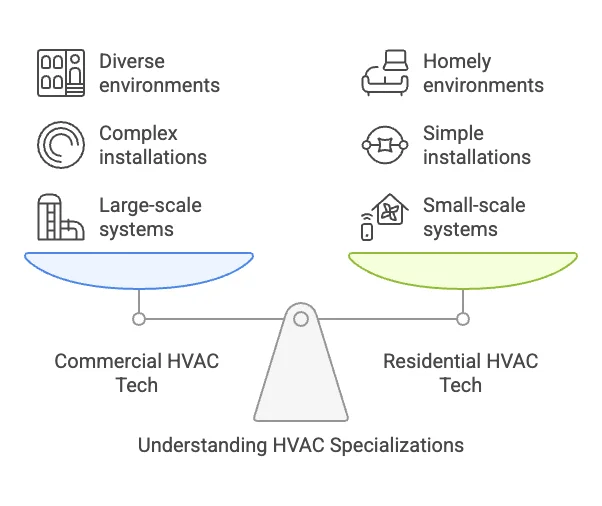
Commercial and residential HVAC apprenticeships offer distinct career paths with different skill requirements, working conditions, and advancement opportunities. Understanding these differences helps prospective apprentices choose the specialization that best matches their interests, aptitudes, and career goals. Both paths provide excellent earning potential and job security, but through different approaches and work environments.
Residential HVAC apprenticeships focus on single-family homes, apartments, and small commercial buildings. These positions emphasize customer service skills, as apprentices regularly interact with homeowners and building occupants. Residential work typically involves smaller, less complex systems but requires versatility across many different equipment types and manufacturers.
Commercial apprenticeships involve larger buildings like offices, hospitals, schools, and manufacturing facilities. These systems are more complex, often featuring centralized equipment, sophisticated controls, and specialized applications. Commercial apprentices typically work in teams and coordinate with other trades, developing project management and collaboration skills.
| Aspect | Residential | Commercial |
|---|---|---|
| System Size | Small to medium | Large, complex systems |
| Customer Interaction | High, direct homeowner contact | Limited, facility managers |
| Work Schedule | Regular hours, some evenings | Standard business hours |
| Travel Requirements | Multiple daily locations | Fewer, longer-duration projects |
| Average Salary | $45,000-$65,000 | $50,000-$75,000 |
Working conditions differ significantly between specializations. Residential apprentices work in various environments, from cramped crawl spaces to comfortable homes, with frequent travel between job sites. Commercial apprentices often work in mechanical rooms, on rooftops, and in large buildings, with less travel but potentially more challenging working conditions.
Career advancement paths vary between specializations. Residential apprentices may advance to service technicians, installation specialists, or eventually start their own businesses. Commercial apprentices might become project supervisors, system designers, or facility maintenance managers. Both paths offer entrepreneurial opportunities, but residential work provides easier entry into business ownership.
Training requirements overlap significantly, but each specialization emphasizes different skills. Residential apprentices focus more on customer service, sales skills, and working independently. Commercial apprentices develop project management abilities, blueprint reading skills, and complex system troubleshooting capabilities. Both require strong technical foundations and safety awareness.
Essential Tools and Equipment for HVAC Apprentices
HVAC apprentices must master a comprehensive toolkit that enables them to perform installation, maintenance, and repair tasks efficiently and safely. Tool proficiency directly impacts job performance, career advancement, and earning potential. Most employers provide major equipment, but apprentices often purchase personal hand tools that become career-long investments.
Basic hand tools form the foundation of every HVAC apprentice's toolkit. Essential items include adjustable wrenches, pipe wrenches, channel lock pliers, screwdrivers, and hex keys. Quality tools from reputable manufacturers like Klein, Ridgid, or Milwaukee justify their higher cost through durability, precision, and reliability. Cheap tools often fail under professional use, creating safety hazards and reducing productivity.
Measuring and testing instruments enable apprentices to diagnose problems and verify system performance. Digital multimeters measure electrical values, while manifold gauge sets monitor refrigerant pressures and temperatures. Thermometers, both digital and analog, help assess system efficiency and identify problems. These precision instruments require careful handling and regular calibration.
Essential HVAC Apprentice Tools:
- Adjustable wrenches (8", 10", 12")
- Pipe wrenches (10", 14", 18")
- Channel lock pliers (various sizes)
- Screwdriver set (flathead and Phillips)
- Hex key sets (metric and standard)
- Digital multimeter
- Manifold gauge set
- Refrigerant leak detector
- Tube cutter and bender
- Cordless drill and bits
- Safety equipment (glasses, gloves, hard hat)
- Flashlight and headlamp
Power tools significantly increase productivity and enable apprentices to handle larger projects efficiently. Cordless drills, reciprocating saws, and angle grinders are essential for installation work. Battery technology improvements have made cordless tools as powerful as corded alternatives while providing superior portability and convenience for field work.
Specialized HVAC equipment requires significant investment but enables apprentices to perform advanced tasks. Refrigerant recovery machines, vacuum pumps, and charging stations are typically employer-provided due to their cost and specialized nature. Understanding proper operation and maintenance of this equipment is crucial for career advancement.
Safety equipment represents non-negotiable investments for HVAC apprentices. Safety glasses, work gloves, hard hats, and steel-toed boots protect against common hazards. Fall protection equipment becomes essential for rooftop work, while respiratory protection may be required in certain environments. The Occupational Safety and Health Administration provides comprehensive guidelines for construction safety requirements.
Launch Your HVAC Career: Next Steps and Opportunities
HVAC apprentice jobs represent an exceptional entry point into a stable, well-paying career that combines technical expertise with hands-on problem-solving. The comprehensive training, immediate earning potential, and clear advancement pathways make HVAC apprenticeships attractive to individuals seeking meaningful work without the burden of student loan debt. As building systems become increasingly sophisticated, skilled HVAC professionals will remain in high demand.
The next step involves researching local apprenticeship opportunities and application requirements. Contact local HVAC contractors, union halls, and community colleges to explore available programs. Prepare for the application process by gathering educational transcripts, obtaining any required certifications, and developing interview skills that demonstrate mechanical aptitude and strong work ethic.
Ready to explore HVAC career opportunities? Visit our comprehensive HVAC salary guide for detailed compensation information, browse current job openings in your area, and connect with industry professionals in our HVAC community forum. Your path to a rewarding HVAC career begins with taking that first step toward apprenticeship application.