Understanding the Current Job Market in 2026
The heating, ventilation, air conditioning, and refrigeration (HVACR) industry is undergoing a significant transformation as we move through the middle of the decade. The current job market in 2026 is no longer defined solely by seasonal residential demands or traditional commercial maintenance. Instead, it's being reshaped by a massive expansion in digital infrastructure and high-density computing. According to the Bureau of Labor Statistics (BLS) data released in 2026, there are approximately 409,670 technicians currently employed in the United States. This workforce is tasked with maintaining an increasingly complex array of systems that support both human comfort and critical technology.
The demand for skilled labor remains high, with the BLS projecting roughly 40,600 annual job openings through the next decade. While many of these roles are created to replace retiring professionals, a substantial portion stems from the expansion of specialized sectors. The current job market in 2026 shows that the industry is growing at a rate of 11%, which is significantly faster than the average for all occupations. For technicians, this translates to high job security and a shift toward higher-paying, mission-critical roles that require a blend of mechanical expertise and digital proficiency.
The Direct Impact of AI on HVAC Demand
The most significant driver of change in the industry is the rapid build-out of artificial intelligence infrastructure. The impact of AI on HVAC demand is most visible in the data center sector, where thermal management has become the primary operational challenge. Traditional data centers typically managed power densities of 5 to 10 kW per rack. However, modern AI-ready facilities now frequently exceed 30 to 50 kW per rack. This fivefold increase in heat generation has made advanced cooling systems the "engine room" of the AI economy.
The impact of AI on HVAC demand has moved beyond simple air cooling. As chips become more powerful, air alone can't dissipate heat efficiently enough to prevent equipment throttling. This has led to a surge in the adoption of liquid cooling technologies. Industry forecasts indicate that liquid cooling, including direct-to-chip and immersion systems, will grow from 20% of the market to over 55% by 2030. For the HVAC professional, this means the current job market in 2026 requires familiarity with coolant distribution units (CDUs), secondary loops, and specialized manifolds that were rarely seen in general commercial work just a few years ago.
Data Center Infrastructure and Thermal Management
Data centers are no longer niche environments for a handful of specialists. The current job market in 2026 features a significant number of roles at "hyperscale" facilities operated by major tech firms. These facilities consume massive amounts of energy—often between 30 MW and 40 MW each—and require 24/7 monitoring of building management systems (BMS). The work involves maintaining massive chiller plants, cooling towers, and Computer Room Air Handler (CRAH) units. Because downtime in these environments can cost millions of dollars per minute, the technicians who maintain them are treated as mission-critical staff and compensated accordingly.
Transitioning to Liquid Cooling Systems
As the impact of AI on HVAC demand intensifies, the industry is seeing a shift toward hybrid cooling models. Many facilities now use a combination of traditional air-cooled HVAC for the room environment and liquid loops for the high-density AI server racks. This complexity requires technicians to understand fluid dynamics, leak detection in sensitive environments, and the chemistry of specialized coolants. The global AI in HVAC market is projected to reach $15.8 billion by 2036, growing at a compound annual growth rate (CAGR) of 22%, driven largely by these sophisticated thermal management needs.
Salary Trends and Compensation Structures
Compensation in the current job market in 2026 reflects the high demand for technical expertise. National wage data shows a clear upward trend, with the median annual wage for HVAC mechanics and installers sitting at $61,010. This represents a steady increase from previous years, as employers compete for a limited pool of qualified talent. However, the median figure only tells part of the story, as specialization in critical infrastructure significantly boosts earning potential.
- Top 10% of Earners: Technicians in the highest bracket now earn more than $95,210 annually. These roles typically involve controls specialists, industrial refrigeration, and data center operations.
- Data Center Specialists: Live job postings in 2026 show that specialized chiller technicians for data center environments can earn between $38.00 and $76.00 per hour.
- Entry-Level Roles: Apprentices and junior technicians can expect starting rates between $18.00 and $24.00 per hour, depending on their region and initial certifications.
- Certification Premiums: Holding advanced certifications, such as NATE (North American Technician Excellence) or specialized manufacturer training, can provide a salary premium of approximately 12.2% over base rates.
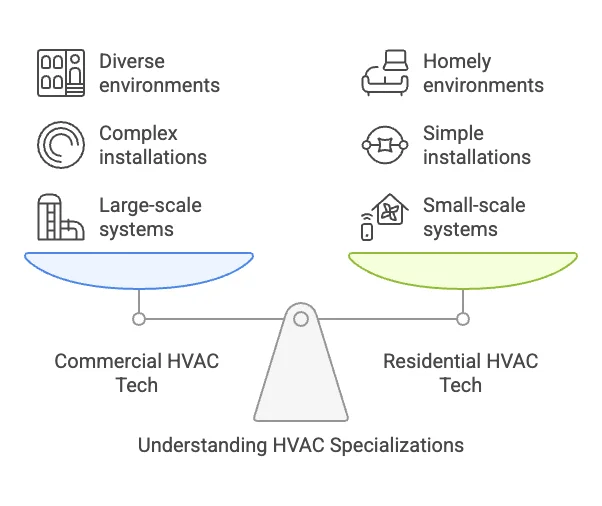
The current job market in 2026 also shows a significant "commercial gap." Technicians working in commercial and industrial sectors typically earn 20% to 30% more than those in purely residential roles. This is due to the increased complexity of the equipment and the higher stakes involved in maintaining climate control for businesses, hospitals, and technology hubs.
High-Growth Locations with Increasing Demand
Geography plays a crucial role in career opportunities within the current job market in 2026. While HVAC work is necessary everywhere, certain regions are experiencing explosive growth due to the concentration of data centers and industrial manufacturing. Identifying locations with increasing demand can help technicians position themselves in markets where wages are higher and opportunities for advancement are more frequent.
The "Silicon Heartland" and the Sun Belt remain the primary drivers of new job creation. Specific locations with increasing demand include:
- Atlanta, Georgia: This market has seen a 52.3% year-over-year increase in data center capacity under construction, with over 2,800 MW currently in the pipeline. This has created an urgent need for mechanical and commissioning talent.
- Northern Virginia: Known as the world's largest data center hub, this region maintains over 4,400 MW of inventory with a vacancy rate of just 0.2%. The demand for technicians here is constant and highly competitive.
- Phoenix, Arizona: With more than 17 million square feet of industrial space under development, Phoenix has become a hotspot for both data centers and advanced manufacturing facilities that require precise climate control.
- Dallas-Fort Worth, Texas: This metro area employs over 9,900 HVAC professionals and continues to lead the nation in new industrial construction, making it one of the most stable locations with increasing demand.
- Columbus, Ohio: As tech giants build out massive campuses in the Midwest, Ohio has emerged as a critical hub for infrastructure technicians, offering a lower cost of living paired with high-tech wages.
The current job market in 2026 also rewards those willing to work in extreme climates. States like Alaska and Massachusetts report some of the highest median wages in the country, often exceeding $75,000, due to a combination of high demand and a limited supply of local technicians.
What to Expect in 2027
Looking ahead to the near future helps professionals prepare for the next wave of industry changes. When considering what to expect in 2027, two major themes emerge: the continued scaling of AI infrastructure and the tightening of environmental regulations. Total U.S. Data center capacity is projected to reach 90 gigawatts (GW) by 2027, up from current levels. This means the pressure on the power grid and the need for high-efficiency cooling will only intensify.
Technicians should also prepare for a broader shift toward decarbonization. What to expect in 2027 includes a more aggressive phase-down of traditional HFC refrigerants and a wider adoption of low-GWP (Global Warming Potential) alternatives like R-454B and R-32. These "A2L" refrigerants are mildly flammable, requiring new tools, safety protocols, and specialized training. Professionals who master these transitions early will be the most sought-after candidates in the current job market in 2026 and beyond.
Furthermore, what to expect in 2027 involves the deeper integration of AI into the HVAC systems themselves. Smart building platforms are now using machine learning to predict equipment failure before it occurs. Instead of responding to a "no-cooling" call, technicians will increasingly be dispatched based on "predictive maintenance" alerts. This shift will require a workforce that is comfortable using digital diagnostic tools and analyzing data from IoT-enabled sensors. The overall HVAC system market is expected to reach a value of $260.58 billion by 2030, reflecting this move toward more intelligent, high-value infrastructure.
Essential Skills for the Next Generation of Technicians
To succeed in the current job market in 2026, the modern technician must move beyond basic mechanical repair. While the "backbone" of the trade remains the ability to fix a compressor or charge a system, the highest-paying roles now demand a broader skill set. Employers are increasingly looking for "Engineering Operations Technicians" who can bridge the gap between traditional HVACR and IT infrastructure.
Key skills that are currently in high demand include:
- Digital Literacy and BMS Proficiency: The ability to navigate complex Building Management Systems and use software-based diagnostic tools is no longer optional in the commercial sector.
- Refrigeration Competency for Data Centers: Understanding large-scale chiller operations and liquid cooling loops is essential for tapping into the data center boom.
- Electrical and Controls Knowledge: As systems become more automated, the ability to troubleshoot low-voltage controls and variable frequency drives (VFDs) is a major differentiator.
- Adaptability to New Refrigerants: Staying current with EPA Section 608 requirements and safety training for A2L refrigerants is critical for compliance and safety.
The current job market in 2026 offers a unique opportunity for those in the skilled trades. While AI is automating many white-collar roles, it's simultaneously creating a massive, physical demand for the people who keep the machines cool. For HVAC professionals, the path forward involves embracing these technological shifts and focusing on the high-growth sectors that are defining the future of the industry. By focusing on specialized training and targeting locations with increasing demand, technicians can ensure their careers remain and high-paying well into the next decade.